how to say “to plant” in Hebrew
having trouble seeing the print?
לִנְטוֹעַ

I will be taking a few days off next week,
so there will be a lapse in Your Daily Dose of Hebrew.

Here’s an entry about vacation.
Today is ט”וּ בִּשְׁבָט , the 15th of the Jewish month of Shevat, the new year for trees.
, the 15th of the Jewish month of Shevat, the new year for trees. This “new years” has religious significance, as well as significance to Israeli schoolchildren, who go out to celebrate the land, learn about the environment and plant trees.
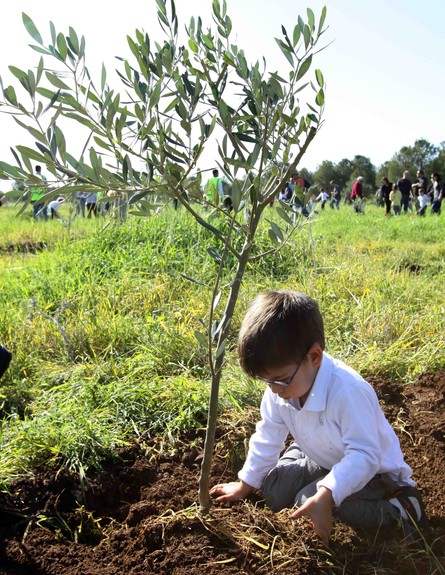
The Hebrew word for to plant is לִנְטוֹעַ , an active-simple verb of the פ”נ variety. Its root is נ.ט.ע (n.t.a).
, an active-simple verb of the פ”נ variety. Its root is נ.ט.ע (n.t.a).For example:
הֵם יִטְּעוּ בְּיַחַד עֵץ.
They will plant a tree together.
Note the dot in the letter ט (t). It’s there to compensate for the נ (n), which has disappeared due to difficulty in pronunciation.
 |
| here’s a song many Israeli children are singing today |
Another Modern-Hebrew form of this word is לָטַעַת , though this form is less widely used.
, though this form is less widely used.Here’s a more detailed Hebrew discussion of this topic.