how to say “I like this” in Hebrew
having trouble seeing the print?
Get talking… in Hebrew.
Our Level 1 course starts
Sunday, November 20
in Jerusalem and Tel Aviv
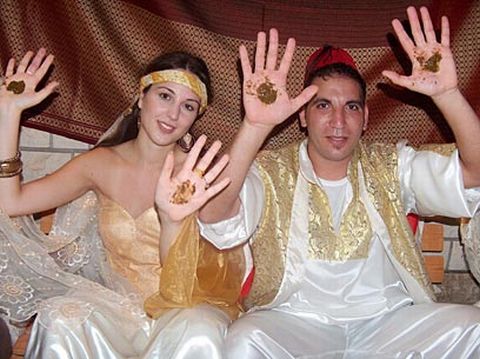
A sweet elderly couple living next door to me invited me to a dinner they were having in honor of their grandson, who was just Bar Mitzvah today. As is accustomed, I just learned, in some Jewish communities from Arab lands, the Bar Mitzvah boy and the whole family (as well as guests) some kind of substance (shown in the picture below) smudged on the palm of their hand, which is then bandaged with a piece of cloth. It’s a form of Henna – חִינָה (KHEE-nah) in Judeo-Arabic. The practice appears much more commonly at Jewish (as well as non-Jewish) weddings of couples from Eastern, Middle-Eastern or North African origin.
The significance? I’m not sure, but everyone was having a good time.
The חינה reminded me of a Hebrew expression dating back to Biblical times that means I like…
You may be familiar with the conventional translation, …אֲנִי אוֹהֵב/ת (ah-NEE oh-HEH/vet – masculine and feminine, respectively). If so, you probably know that לֶאֱהוֹב (leh-eh-HOHV) means both to love and to like. Thus one must use the word לאהוב with caution, lest an awkward misunderstanding arise.
A way to get more specific about one’s feelings is to use the term, לִמְצוֹא חֵן בְּעֵינֵי… (leem-TSOH khen beh-eh-ee-NEH-ee…) – literally, to find favor in the eyes of… For example, I might say, הַמַּחְשֵׁב הַזֶּה מוֹצֵא חֵן בְּעֵינֶיה (hah-mahkh-SHEV hah-ZEH moh-tseh KHEN beh-eh-ee-NEH-hah) – She likes this computer. Or, I might say, הַבָּחוּרָה הַזֹּאת מוֹצֵאת חֵן בְּעֵינָיו (hah-bah-khoo-RAH hah-ZOHT moh-tset KHEN beh-eh-ee-NAHV) – He likes this girl.
…למצוא חן בעיני implies fondness, not necessarily love.
Further build your Hebrew vocabulary with… |