how to say “heatwave” in Hebrew

 
This one was requested by Ruti. If you would like to request a word to be featured on Ktzat Ivrit, please click.
 
It’s still summer in Israel. The bike ride from my rented German Colony apartment to Yeshivat HaKotel in the Old City (where I deliver Ivrit La-Inyan classes) requires that I take an extra shirt to change into when I arrive – since by the time I get to my destination, my shirt is too wet to run a class with the proper decorum.
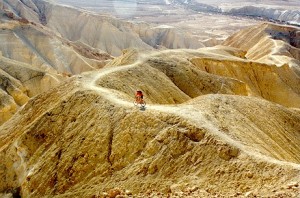
 
שרב במדבר
It’s not me on the bike… but the picture gets the point across.
 
 
A few weeks ago, however, it was so hot that even my second shirt wasn’t enough. That type of weather is called, in Hebrew, שָׁרָב (shah-RAHV). The word appears in Biblical Hebrew, in Isaiah 49.
 
Another term commonly used by Israelis to describe such inclement weather is חַמְסִין (khahm-SEEN). According to Israeli environmentalist Dr. Oded Potchter, this word comes from Arabic and refers to the Arabian tradition that fifty such days a year exist (in the Middle East, I guess). The Arabic word for fifty is خمسون (khahm-SOON), which is pretty close to khahm-SEEN.
 
That’s the major difference between שרב and חמסין – Hebrew versus Arabic.

Similar Posts

  • how to say “from the start” in Hebrew

    Today's Video Below ⬇️ מִלְּכַתְּחִילָּה If you’ve had some experience with Hebrew, you probably know the word התחלה - beginning, as in: ספר לי שוב, מההתחלה. Tell me again, from the beginning. התחלה comes from the הפעיל verb להתחיל - to start, whose root is ת.ח.ל. This root gives us a more sophisticated word, מלכתחילה...
  • how to say “to hand over” in Hebrew

    [audioclip url=”https://archive.ulpan.com/wp-content/uploads/2020/06/להסגיר-#.m4a” /]לְהַסְגִּיר Yesterday we saw the words להחביא[audioclip url=”https://archive.ulpan.com/wp-content/uploads/2020/06/להסגיר-#.m4a” /] – to hide (something physical) and להסתיר[audioclip url=”https://archive.ulpan.com/wp-content/uploads/2020/06/להסגיר-#.m4a” /] – to hide (something non-physical, such as a fact). To take something out of hiding (to expose it), or to hand someone over (to extradite them), is להסגיר[audioclip url=”https://archive.ulpan.com/wp-content/uploads/2020/06/להסגיר-#.m4a” /], a הפעיל verb of the root ס.ג.ר[audioclip url=”https://archive.ulpan.com/wp-content/uploads/2020/06/להסגיר-#.m4a”…

  • how to say “parents” in Hebrew

    [audioclip url=”https://archive.ulpan.com/wp-content/uploads/2015/05/הורים-1.m4a” /]הוֹרִים English speakers who didn’t grow up using the kh sound (as in chutzpah) often find it difficult to distinguish between the Hebrew h and kh sounds. Thus when they learn Hebrew, they might confuse the words חורים[audioclip url=”https://archive.ulpan.com/wp-content/uploads/2015/05/הורים-2.m4a” /] – holes and הורים[audioclip url=”https://archive.ulpan.com/wp-content/uploads/2015/05/הורים-1.m4a” /] – parents. הורים is the plural form of הורה[audioclip url=”https://archive.ulpan.com/wp-content/uploads/2015/05/הורים-3.m4a” /] – a…

  • how to say “to pet” in Hebrew

    [audioclip url=”https://archive.ulpan.com/wp-content/uploads/2019/04/ללטף-#.m4a” /]לְלַטֵּף The Hebrew word for to pet or to caress (a human being as well) is ללטף[audioclip url=”https://archive.ulpan.com/wp-content/uploads/2019/04/ללטף-#.m4a” /]. For example: [audioclip url=”https://archive.ulpan.com/wp-content/uploads/2019/04/ללטף-#.m4a” /]איזה כלב חמוד שם בפתח, בא לי ללטף אותו. What a cute dog there in the doorway, I feel like petting it. ללטף is a פיעל verb whose root is ל.ט.פ[audioclip url=”https://archive.ulpan.com/wp-content/uploads/2019/04/ללטף-#.m4a” /]….

  • How to say optimal in Hebrew

      having trouble seeing the print? אוֹפְּטִימָלִי, מֵיטָבִי     Check out our spring coursesin Jerusalem, Tel Aviv, Raanana, Efrat and Ramat Beit Shemesh      The word meaning optimal you’re most likely to hear in Spoken Hebrew is אוֹפְּטִימָלִי (ohp-tee-MAH-lee). But the Israeli media is control of much of public opinion as well as public language, and today I saw an article in a major…

  • how to say “spark” in Hebrew

      having trouble seeing the print? נִיצוֹץ   Announcing our mid-winter session! נִיצוֹץ (nee-TSOHTS) means spark in the physical sense, but the word is used far more often to refer to that spark of life, what some might call a divine spark, within us all – without exception.  The word is an onomatopoeia, just like the English word crackle. …