
how to say “watermelon” in Hebrew
[audioclip url=”https://archive.ulpan.com/wp-content/uploads/2015/05/אבטיח-1.m4a” /]אֲבַטִּיחַ
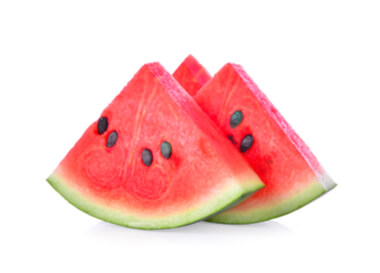
This word appears already in Biblical Hebrew, as אבטיח[audioclip url=”https://archive.ulpan.com/wp-content/uploads/2015/05/אבטיח-1.m4a” /] – watermelon – native to southern Africa, was cultivated in Egypt and eaten by the People of Israel.
In researching the word, I spotted the root ב.ט.ח[audioclip url=”https://archive.ulpan.com/wp-content/uploads/2015/05/אבטיח-2.m4a” /], which normally means safety as the word ביטחון[audioclip url=”https://archive.ulpan.com/wp-content/uploads/2015/05/אבטיח-3.m4a” /] – security. I started pondering possible connections but, coming up dry, I realized that אבטיח and ביטחון may have different roots entirely. I confirmed this when I saw that the corresponding words in Arabic have two different het sounds: although in Hebrew we use the same letter ח[audioclip url=”https://archive.ulpan.com/wp-content/uploads/2015/05/אבטיח-4.m4a” /] to spell the two words, in Ancient Hebrew this ח represented two sounds, a guttural h[audioclip url=”https://archive.ulpan.com/wp-content/uploads/2015/05/אבטיח-5.m4a” /] and a coarser kh[audioclip url=”https://archive.ulpan.com/wp-content/uploads/2015/05/אבטיח-6.m4a” /].
Now let’s put academics aside and put אבטיח into modern-day useful context:
[audioclip url=”https://archive.ulpan.com/wp-content/uploads/2015/05/אבטיח-7.m4a” /]בימי הקיץ החמים, אין כמו אבטיח שבדיוק יצא מהמקרר.
On hot summer days, there’s nothing like watermelon that just came out of the fridge.