
how to say “a briefing” in Hebrew
having trouble seeing the print?
Today I visited one of our Jerusalem client programs on their first day of class. I got into a conversation with some of these post-high-school students from English-speaking countries about how they spent this past summer. Their group level corresponds to Ulpan La-Inyan’s Level 2 course.
One of the girls said she was a camp counselor, so I asked her whether she knows the term for such a counselor or a guide in Hebrew. I could see her grabbing for the word – it was at the tip of her tongue.
When I said the word was מַדְרִיכָה (mahd-ree-KHAH) for her and מַדְרִיך (mahd-REEKH) for the boys, she said that of course she knew it. The word was in her passive vocabulary – but not yet in her active.
Then I went on to ask them what the word’s root might be, so one of the boys piped in and said he thinks it’s related to דֶּרֶך (DEH-rekh), meaning path or way. I explained that what a מדריך or מדריכה does is shows people the way. Another student recalled that the act of guiding or being a camp counselor, in Hebrew, is הַדְרָכָה (hahd-rah-KHAH). This family of words falls into the active-causative הפעיל (heef-EEL) verb form.
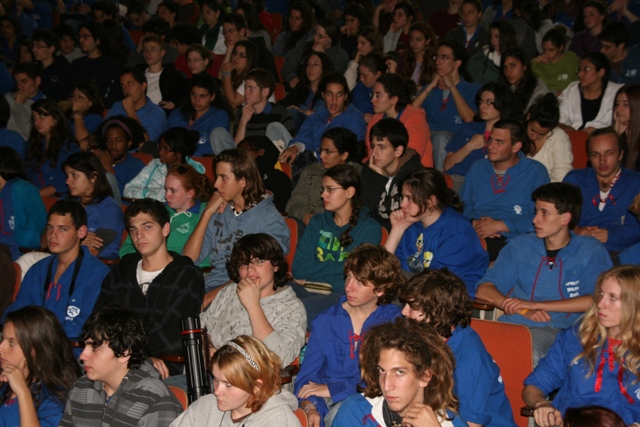
Now, these guys are taking a Level 2 course. If they were more advanced, I may have introduced a related word: תִּדְרוּך (teed-ROOKH). Whereas הדרכה is the general act of guiding, תּדרוך refers to the more specific act of guiding briefly… or briefing. For example, in the picture above, הַחֲנִיכִים מְקַבְּלִים תִּדְרוּך – the students/youth group members are getting briefed (literally, receiving a briefing) – (hah-khah-nee-KHEEM meh-kah-beh-LEEM teed-ROOKH).
Likewise, to brief someone is לְתַדְרֵך (leh-tahd-REKH).
תדרוך and לתדרך fall into a derivative version of the active-intensive פיעל (pee-EL) verb form.

I’ve seen his amazing art at Hechal Shlomo and even acquired a piece myself.