
Hebrew Alphabet Steps
Learning the Hebrew alphabet may seem daunting at first. But if you follow the steps and suggestions in this article, you’ll become a master in no time.
Why Learn the Hebrew Alphabet?
Israel has become a very attractive destination for people of all walks of life, from ardent Zionists and Jews who feel that “their heart is in the east” (east of Europe and America, anyway), to journalists, diplomats and international business people looking to get in on the action of the Start-Up Nation.
But while it’s certainly possible to get by in major Israeli cities where virtually everyone speaks at least rudimentary English, even those most content being tourists often still wish to really get in on the Israeli action, understand the Israeli mindset, maybe find an Israeli mate – and the gateway to this is the Hebrew language.
Learning to read Hebrew – whose first step is to learn the Hebrew alphabet – opens you up not only to the Modern Hebrew language and the culture of Modern Israel, but also to Jewish history and literature.
To learn the Hebrew alphabet is to have access to the Hebrew Bible, which interests not only religious scholars but also anyone wishing to understand Jewish history. The Bible is the beginning of the story of the Jewish people, who have mixed in with cultures across the diaspora from India and Arabia to Europe and the Americas, speaking dozens of languages, but always praying in Hebrew and composing religious scholarship and poems of longing in Hebrew – using the Hebrew alphabet.
To learn the Hebrew alphabet is also to open the door to other languages spoken by Jews throughout history: Yiddish, Ladino and Jewish Aramaic – which makes up the Talmud and Kabbalah – are all written using the Hebrew alphabet.
Now back to Modern Israel. Let’s say you’re dating an Israeli and it’s time to get to know their family, who speak only Hebrew. Why not just learn to speak without bothering to learn to read Hebrew?
Because being able to read the language you’re learning makes the process much easier. It enables you to use dictionaries and translation software much more easily and efficiently – it’s just an upgrade to the learning process. And what’s the first step in reading Hebrew? It’s to learn the Hebrew alphabet.
History of the Hebrew Alphabet
Jewish mystics have hailed the Hebrew alphabet as “foundation letters” with which God created the world, finding in the letters secrets of human origin and destiny. But even according to skeptics, the Hebrew alphabet has a place among the transformational writing systems of the world – albeit one generation or two removed.
The story of the Hebrew alphabet is very much the story of all alphabets. The ancient Phonecians of the land known today as Lebanon (just north of Israel) saw the need for a writing system based on sounds (despite their striking similarly, “Phonecian” and “phonetic” do not derive from the same source), so they composed an alphabet of 22 letters, each representing a consonant. This idea of a phonetic alphabet traveled across Europe, giving rise to Greek and Latin script, but it also traveled more locally – south, to the Canaanites and the Hebrews.
The original Phonecian and Proto-Hebrew letters were basic drawings of items related to the sound they made – for example, the letter Alef – pictured here in traditional and modern fonts – was a picture of an ox, one of whose names in Hebrew is Aluf. Scholars call this initial stage in the evolution of the Hebrew alphabet כתב עברי קדום – Ktav Ivri Kadum, “ancient Hebrew writing”. Jews wrote using this form of the Hebrew alphabet in the early biblical period, until the time they returned from the Babylonian exile, when they adopted the Aramaic script used today.
But despite having changed form over time, the Hebrew alphabet remains 22 letters – with five of those letters changing form when appearing at the end of a word.
The Hebrew Alphabet
The complexity of the Hebrew and English alphabets distinguishes between them. The thickness of the Hebrew letters varies, which helps to distinguish one letter from another in various circumstances. Its letters, on the other hand, are written from right to left, whereas the English alphabet is written from left to right. You could find it tough to learn them at first because we’re used to learning the English language in that manner, but it won’t be an issue for long.
The Hebrew alphabet is quite similar to the Assyrian script, as we already know. This language has no vowels and is known as the square script or the block script, depending on who you ask. Instead of adding letters, vowels are expressed by adding specific types of marks to the existing letters.
Recognizing the letters
But, because we’re talking about learning the Hebrew alphabet right now, we’ll walk you through the steps so you can learn it right away.
Let’s separate the 22 alphabets into 5 groups:
Group 1
| ד | ג | ב | א |
| Dalet | Gimmel | Bet | Alef |
Group 2
| ח | ז | ו | ה |
| Khet | Zayin | Vav | Hey |
Group 3
| ל | כ | י | ט |
| Lamed | Kaf | Yod | Tet |
Group 4
| פ | ע | ס | נ | מ |
| Peh | Ayin | Samekh | Nun | Mem |
Group 5
| ת | ש | ר | ק | צ |
| Tav | Shin | Resh | Kuf | Tzadi |
Group 6 (the final letters)
| ץ (צ) | ף (פ) | ן (נ) | ם (מ) | ך (כ) |
| Final Tzadi | Final Peh | Final Nun | Final Mem | Final Kaf |
To simplify the process, all you have to do now is concentrate on the first three groups – we believe that going group by group will make the learning process easier and save us a lot of time. So close your eyes and take a deep breath. Declare to yourself that you are capable of completing the task; begin with these three sets of the group.
Try saying it out loud while you practice because it will make the process of memorizing much easier. When you’ve finished rehearsing them, try saying them out loud again without looking at them. Check your initial shot to see how many you can tell. Once you’ve figured out all 12 of them, it’s time to move on to the other groupings.
Carry on with the same procedure as before. Once you’ve memorized them all, try saying them all out loud. You will notice that you have learned the entire Hebrew alphabet in a short period of time.
Solidifying recognition
Now that you can name and recognize the letters, let’s start writing. Start writing the names of the characters on a sheet of paper using a pencil (so you can erase them if you make a mistake). Remember to leave a gap between each character’s names because we’ll be writing the Hebrew alphabet beside them later.
It’s time to write the Hebrew alphabet after you’ve finished writing the names of the characters. Of course, you won’t be able to write them without first practicing them. So create a chart with all of the Hebrew letters written on it and try to replicate them alongside the character names. Because our primary goal is letter recognition, your handwriting does not need to be faultless at this time.
The reason we asked you to put the letters next to the names is so that you can readily grasp the names of each alphabet when you go back to review the page. When you feel certain that you understand the alphabet and can write it without looking at it, turn to a new page and practice writing it until you can write it all at once.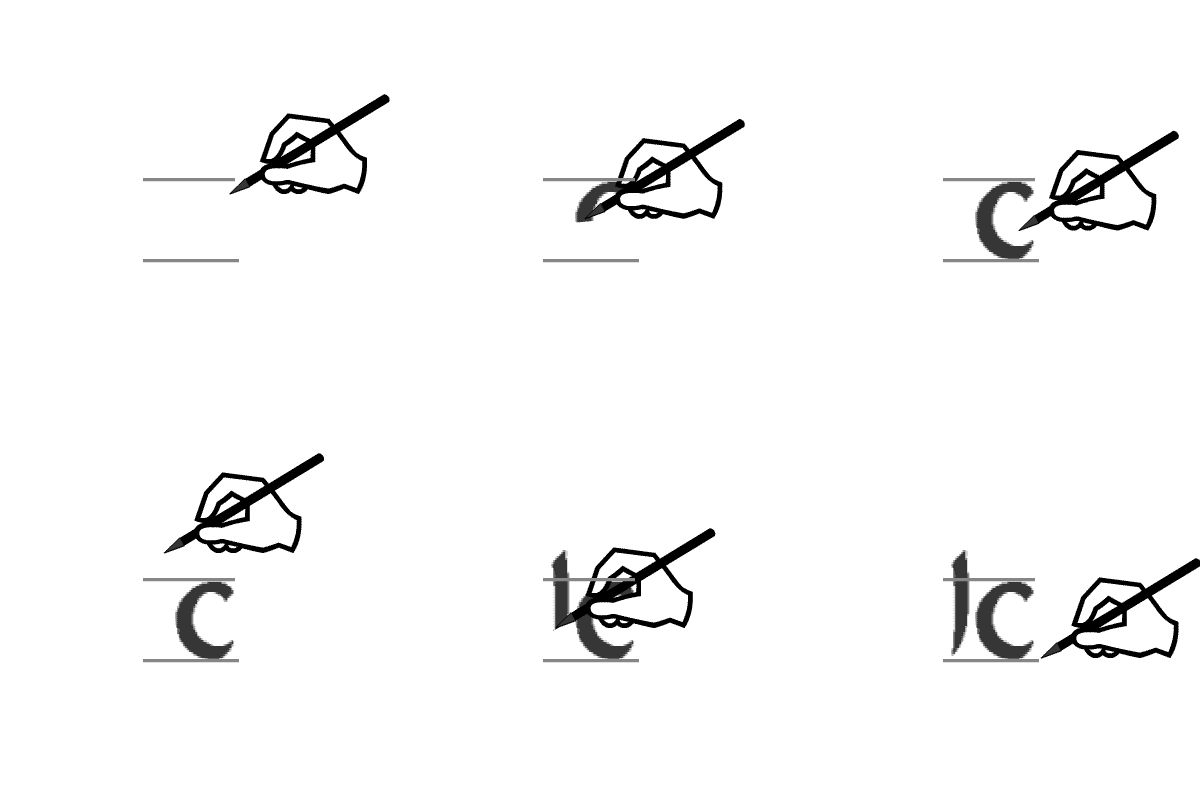
Voila! You now understand the Hebrew alphabet and how to write it – at least in block letters (to learn to write in Hebrew script, visit this page). You can also keep track of the time to see how much time it took you to learn them. You’ll be amazed to learn that it took significantly less time than you anticipated.
A few caveats
We mentioned earlier that Hebrew uses vowel marks to distinguish certain sounds. One of these marks is a dot inside or above a letter.
A dot inside certain letters gives them a harder sound. Some people even call the letter by a different name.
Here are those letters:
|
פּ – Peh hard p sound |
כּ – Kaf hard k sound |
בּ – Bet hard b sound |
|
פ – Feh soft f sound |
כ- Khaf soft kh sound |
ב – Vet soft v sound |
A dot above the letter ש – Shin gives it either a sh or s sound:
| שׂ – Sin | שׁ – Shin |
| s sound | sh sound |
How Hard is it to Learn Hebrew?
Now, learning to speak Spanish or German does have its challenges for English speakers, but these languages have the luxury of the same alphabet as English. Hebrew, however, has a different alphabet that may seem scary at first, especially since it’s written from right to left, but really isn’t that difficult to master – as you’ll see in our video tutorials.
On a scale of 1-10 where 10 is “very difficult to learn for English speakers”, Hebrew would be about a 5 (Spanish and German would be a 1 because they’re super easy and phonetic. Polish is a 2 because it uses the Latin alphabet with some changes but is still phonetic.
French is 3 because it doesn’t read entirely phonetically, Russian is a 4 because it uses a different alphabet, although still reading from left to right. Hebrew is a 5 because its consonants are phonetic but its vowels are implied and it reads from right to left, Arabic is a 6 because many of its letters change form depending on where they appear in the word and because it has lots of sounds that are totally unfamiliar to English speakers… and Chinese is a 10 (because it’s… well, Chinese).
How to Learn the Hebrew Alphabet Quickly
When you sit down to learn a language, you must start from the beginning. Alphabets are the building blocks of learning a language, just as cells are the building components of life. With that said, having a few mnemonic devices accessible would be sufficient in this situation if you want to quickly establish the foundation (which is the alphabets) for your Hebrew language.
A mnemonic device is any approach or technique that aids in the retention or commitment of information to memory. That is why we have devised several mnemonic devices with which we believe you can learn the Hebrew alphabet more quickly. Here are some tips to help you learn faster:
1. Use our tutorial videos
Our five short videos will help you learn to recognize the Hebrew alphabet quickly. Start with this one. Make sure to take the quiz after watching each video.
2. Find and memorize a Hebrew alphabet song or poem
Do you recall learning your ABCs as a child by listening to alphabet songs? Simply by listening to Hebrew alphabet rhymes/songs, you can quickly and effectively learn the Hebrew language.
Because it tends to play again and again in your mind on repeat, it’s one of the best ways to memorize the Hebrew alphabet. You can memorize it just like the first person who taught you the alphabet with musical accompaniment.
This video will help. After some time, you’ll notice that you’re mentally reciting the alphabet. Say that out loud as many times as you can. You must, however, learn how to write it for practice.
3. Hand-write the letters of the alphabet
Studies show that writing speeds up the learning process far more than reading and retaining information. That is why we recommend that you employ the writing approach to quickly improve your alphabet skills.
Group the alphabets first once more. Then choose a set and set a deadline for learning to write them within that time limit. Begin the process again with the other groupings. Use this page to learn the special cursive form of the letters. You’ll notice that you’ve mastered all of the Hebrew alphabets in a short period of time.
Of course, you can make it more exciting by purchasing a dedicated notebook for this purpose. Carry it with you wherever you go so you may practice whenever you have free time. Traveling by train or bus? Are you waiting for someone? Get your notebook out and scribble the Hebrew alphabet or the letters you’re learning in it.
4. Memorize letters by making associations
This is yet another intriguing approach for learning Hebrew letters quickly. This technique asks you to recite the Hebrew letter aloud and then come up with a term from your own language that sounds similar to it.
This is a fun game that you can play with your friends and family, since deciphering a term that sounds like the alphabet is a fun challenge. You can also give points to anybody who can come up with a clever phrase. The person with the most points is the winner.
This method can help you recall the letter by forming a phonic link with the letter. It’s much better if the connection is something you can draw or imagine. As a result, take a look at your alphabet chart and try to think of a word that will help you remember the alphabet.
5. Now go ahead and try to write some words!
Try writing in Hebrew words from your own tongue. Your understanding level will improve as well, allowing you to learn the Hebrew alphabet more quickly. You can see if anyone can read these by posting them on various Hebrew language boards. When you start writing words that native speakers can understand and recognize, you’ll be so proud of yourself.
Conclusion
It is not difficult to learn the Hebrew alphabet. All you have to do now is discover an engaging and efficient technique to memorize them, and you’ll be part of a community of people who know the Hebrew alphabet! Although some people may find writing these alphabets difficult, they should practice as often as possible. You can learn the Hebrew alphabet in this method.